Dominican Identity
One thing I ask of the Lord. This I long to dwell in the house of the Lord,
all the days of my life.
One thing I ask of the Lord. This I long to dwell in the house of the Lord,
all the days of my life.

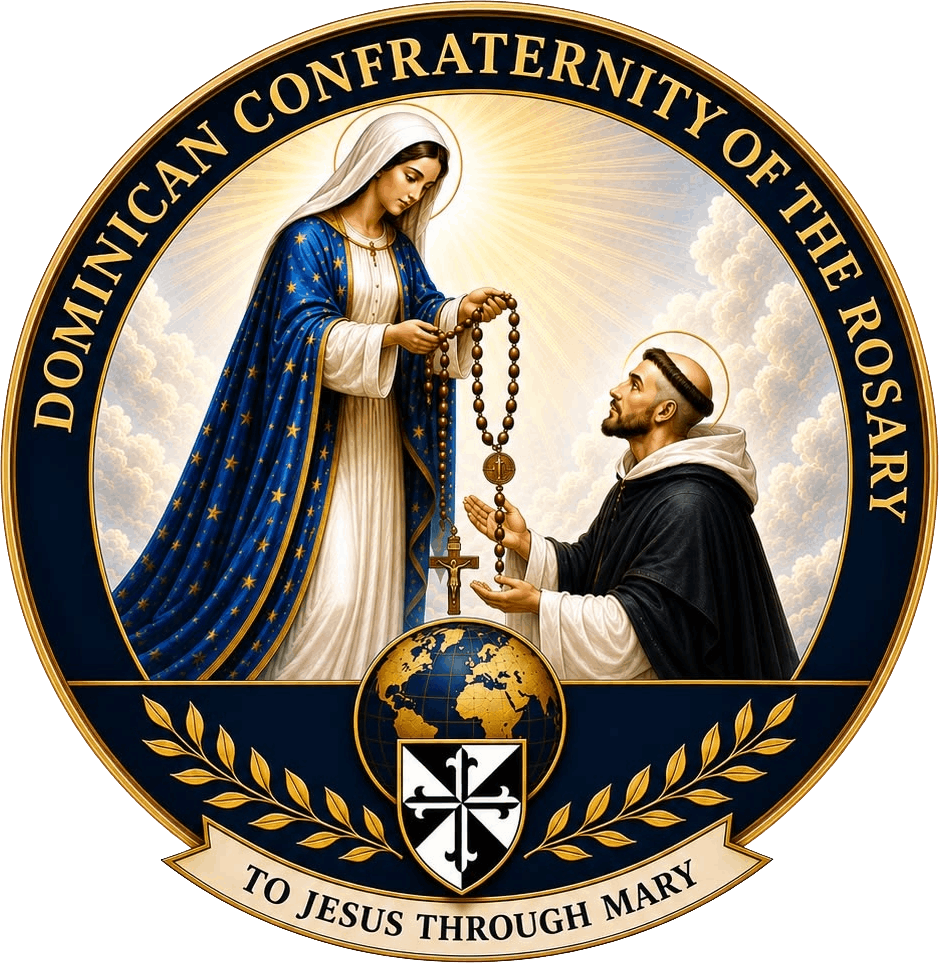
In the hour of the Albigensian darkness, the Blessed Virgin appeared to Saint Dominic. She placed the Rosary into his hands: the meditation on the mysteries of her Son joined to the Angelic Salutation. She promised that through it, the Order of Preachers would crush heresy and save souls. The Church received this. The Church handed it down.
\r\nFor two centuries the flame burned. Then it dimmed. The faithful forgot the mysteries. The Hail Mary became empty sound. But heaven does not abandon its gifts. In the fifteenth century, the Blessed Virgin appeared to Blessed Alan de la Roche, a son of Saint Dominic. She showed him the ruins and commanded: Restore my Psalter. He obeyed. He re founded the Confraternity of the Most Holy Rosary. He taught the people to pray the fifteen mysteries. He inscribed their names in the Register and bound them into one body, living and dead, so that no member would ever pray alone. The fruit was immediate. Heresies collapsed. Nations converted. The Rosary became the voice of the Church Militant.
\r\nThen came the modern eclipse. But again, heaven acted. In 1898, Pope Leo XIII, himself a member of the Confraternity, issued Ubi Primum. He did not create something new. He recognized what the Church already possessed and gave it universal form. He placed the Confraternity under the Master General of the Order of Preachers. He opened the treasury of indulgences, plenary on enrollment and on the seven principal feasts of Our Lady. He declared: this is the Church\'s own weapon.
\r\nThe Sovereign Pontiffs have enrolled and led from within. Pope Saint Pius V attributed the victory at Lepanto to the Rosary and established the feast of Our Lady of the Rosary for the whole Church. Pope Saint John Paul II declared the Rosary his favourite prayer and added the Luminous Mysteries, making explicit what was always implicit: the public ministry of Christ, the bridge between the Joyful and the Sorrowful.
\r\nThe saints have fought in these ranks. Saint Louis de Montfort consecrated multitudes through it. Saint John Vianney called it his constant companion and declared: If you are in the Confraternity, you have brothers and sisters in every corner of the world who pray for you. Saint Maximilian Kolbe offered his death through it. Saint Padre Pio called it his weapon. Saint Josemaría Escrivá taught it as the path of ordinary holiness.
\r\nThe development is clear. The substance has not changed. The form remains: vocal prayer, meditative contemplation, offering for souls. What began with Saint Dominic in the thirteenth century, was restored by Blessed Alan in the fifteenth, was universalized by Pope Leo XIII in the nineteenth, and was enriched by Pope Saint John Paul II in the twenty first, continues now as the same weapon, the same promise, the same battle.
\r\nThis is not a devotional club. It is the Church Militant arrayed for combat. The errors of this age are the new Albigensians. The weapon is the same. The Blessed Virgin waits.
\r\nTo enroll is to take up the weapon heaven provided. To pray the mysteries is to stand in the battle line. To belong to the Confraternity is to fight for the triumph of the Immaculate Heart, not as distant hope, but as present reality wrought in the hearts of those who pray.